Lot II
Fine Art & Paintings
in Delray Beach
Oils, watercolours, bronzes, and prints.
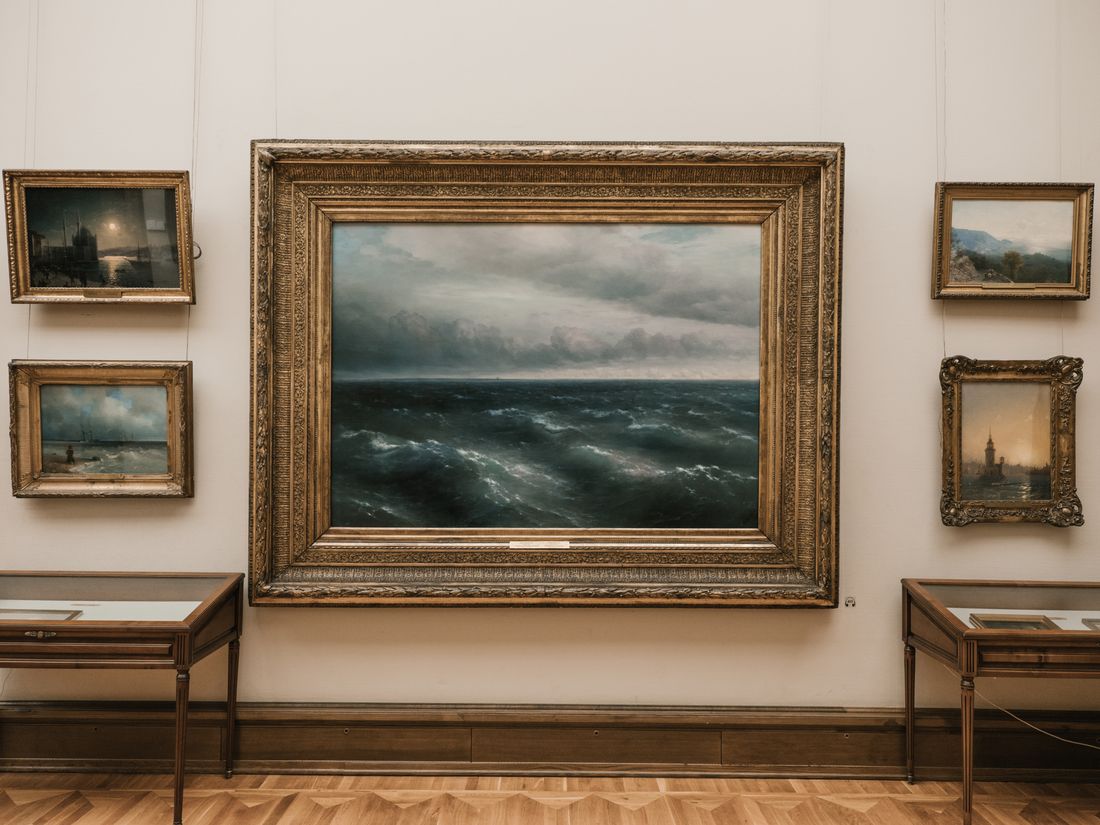
A painting rarely announces what it is. The signature may be a decorator’s flourish, the frame may be older than the canvas, and the “oil” may be a very good print. Before we talk price, we ask the same short list of questions a gallery registrar would ask. Here is how we work through them in a Delray Beach living room, and why Florida’s own painting history makes the answers more interesting than most people expect.
What we look for
- Oils and watercolours by listed artists
- Florida Highwaymen landscapes
- Bronze and marble sculpture
- Antique and gilt frames, prints, and drawings
How we evaluate a painting — the questions we ask first
Age alone does not set a painting’s value. Attribution, quality, subject, condition and buyer interest all carry weight, and an old picture by an unknown hand can be worth less than a clean one by a name collectors chase. We start with the object itself, in this order:
- Original or print? Under a loupe, a print shows a regular dot or line pattern, a flat uniform surface, and edges that stop where the paper stops. A painting shows irregular brushwork, raised paint, and strokes that follow the weave of the support. A good reproduction can fool the eye across a room, and rarely survives a magnifier.
- The back. The reverse often tells you more than the front. We look for gallery, framer, auction and exhibition labels, inventory numbers, stamps, handwritten names and dates, and old price marks on the canvas, the panel, the stretcher and the frame.
- The signature. A signature is a clue, not proof. We read it under raking light, compare it with known examples, and test other spellings. Plenty of genuine paintings are unsigned, and plenty of signed ones carry a name that was added later.
- Listed or unlisted. A “listed” artist is one with a documented market, with sale records, exhibitions and a recognizable body of work. An unlisted artist can still paint beautifully, but without a track record the value rests on quality and decorative appeal alone. A true opinion on a listed name is a specialist’s call, and we say so when a piece needs one.
- The frame. An old frame has its own value and charm, but it does not prove the painting inside is equally old. Frames get swapped, and a handsome period frame on a modern picture is a common dressing-up trick.
- Condition. Tears, holes, staining, flaking or lifting paint, heavy craquelure, old repairs and signs of relining all move the number. Over-cleaning and heavy overpainting move it further.
Florida has its own school, and we know it. The Florida Highwaymen were a group of 26 African American landscape painters from the Fort Pierce area. From the mid-1950s into the 1980s they painted fast, on cheap Upson board or Masonite, framed the pictures in crown molding brushed with gold or silver paint, and sold them from car trunks along the coastal roads, State Road A1A and U.S. 1. By one estimate they sold some 200,000 paintings. Early works sold for a few dozen dollars. Today the founders’ best pieces reach into the thousands, and the top results far beyond that.
That success is exactly why caution matters. Because the originals were made quickly and sold cheaply, the market is full of “Highwaymen style” pictures, misattributions and outright fakes. A “1960s” scene on modern canvas board, or one in suspiciously pristine condition, is a warning sign. Genuine period pieces tend to show the cheap board, the household-molding frame and honest age. We check all three, and we check who the named artist actually was.
The science most buyers (and most dealers) never mention
Museums and conservation labs no longer rely on a connoisseur’s eye alone. Published research in computer vision and spectroscopy has turned the surface and the paint layers of a picture into measurable data. We do not run a lab in your home, but knowing what the lab can read is what keeps our appraisal honest.
Pigments as a time stamp. Every pigment has a first date of manufacture. X-ray fluorescence (XRF) scans a painting point by point and records which elements are present, and reading those spectra by hand is slow expert work. Researchers have now trained deep-learning models to identify pigments from a single-pixel XRF spectrum, including layered and mixed paints and pigments in low concentration. They tested the approach on lab-made mock-ups and on two famous works: Gauguin’s Poèmes Barbares (1896), which hides an earlier painting underneath, and Cézanne’s The Bathers (1899–1904). The model matched the results of conventional elemental mapping. The practical meaning for a buyer is simple: a pigment that did not exist in the supposed year is one of the hardest things for a forger to hide.
Cracks as a fingerprint. Craquelure, the network of fine cracks in aging paint, depends on the support, the ground, the paint and the climate a picture has lived through. Researchers have modeled crack patterns as graphs, with junctions as nodes and fractures as edges, and used graph neural networks to classify paintings by origin, reporting that the combined approach beat existing techniques by a large margin. A separate 2026 paper treats crack detection as an inverse problem, splitting an image into a clean painting and a crack layer, because cracks are easily confused with brushstrokes. The point for us: natural cracking is irregular and layered, while quick “aging” of a new picture tends to look uniform.
Machine-learning attribution. In one study, a one-class classifier read texture and colour features from both ordinary photographs and X-ray images of 24 authenticated Goya paintings. It reached 97.8% accuracy with a false-positive rate of 0.022, and gave one test painting a 92.3% authentication confidence. The sample is small, so it is a demonstration, not a verdict machine. Other teams train a classifier to recognize a specific forger rather than an artist’s style, using EfficientNet and Kolmogorov–Arnold networks on works from the Wolfgang Beltracchi forgery case, and still others add synthetic paintings to scarce training data to improve attribution.
None of this replaces a specialist, and for a six-figure attribution we will tell you to commission one. But it shows where the real evidence sits: in the materials and the paint film, not in the signature in the corner.
What actually drives the value
- Artist and attribution. A documented, listed name carries the premium. For the Florida Highwaymen, the earliest and best work by the leading painters is what collectors chase, and recent auction figures put typical originals at roughly $2,000–$8,000, with a few top results well above that. Later, quicker pieces by lesser-known members trade for far less, sometimes a few hundred dollars.
- Period and size. Larger, carefully painted works from the 1960s outrank small commercial pieces made once the paintings were already selling. Market prices for the group peaked around 2005 and have settled since, so old price lists mislead.
- Quality and subject. Strong composition, confident handling and a desirable scene (a sunset river, a poinciana in bloom, a quiet beach) beat a weak picture by a famous hand.
- Condition and honest restoration. Stable paint and an original surface bring more than a heavily overpainted one. Documented, conservation-grade work is acceptable. Over-cleaning is not.
- Provenance. Labels, receipts, exhibition history and a family story that checks out all add confidence.
We price what is in front of us and say plainly when a picture is decorative rather than collectible. If it needs a specialist or a lab, we tell you before we make an offer.
Not sure if your piece fits? Text a photo to (561) 465-3536 — we will tell you honestly and for free, with no obligation to sell.
Questions
Selling fine art & paintings in Delray Beach
How can I tell if my painting is an original or a print?
Use a magnifier. Prints show a regular dot or line pattern and a flat, uniform surface. Paintings show irregular brushwork, raised paint, and strokes that follow the texture of the canvas or board. Also check the back for labels and stamps. If you are still unsure, send us a clear photo of the front, the back and a close-up of the signature.
What are the Florida Highwaymen, and are their paintings worth money?
They were 26 African American landscape painters from the Fort Pierce area who sold quick oil landscapes from car trunks from the mid-1950s into the 1980s. Originals on Upson board in crown-molding frames are collectible; typical auction results run roughly $2,000–$8,000, with top results far higher for the leading founders. Fakes and “Highwaymen style” copies are common, so send us photos before you sell or buy one.
My painting is unsigned. Is it worthless?
No. Many genuine paintings carry no signature, and a signature alone never proves attribution. Labels on the back, the materials, the style and the condition tell us more. An unsigned picture of good quality still has value. It is simply worth more once the maker is identified.
Should I clean or reframe a painting before selling it?
Please don’t. Amateur cleaning can remove original paint, and a new frame hides evidence on the old one. Dust it gently if you must and leave the rest to us. An honest, untouched surface is easier to value than a freshly “improved” one.
Will you come to the house to see paintings in Delray Beach or Palm Beach County?
Yes. We visit homes across Delray Beach and Palm Beach County, look at each painting in good light, check the front and back, and pay the same day for what we buy. For a single picture, a few photos by text are enough to start.
We also buy