Lot VIII
Asian & Tribal Art
in Delray Beach
Jade, bronze, scrolls, and carvings.
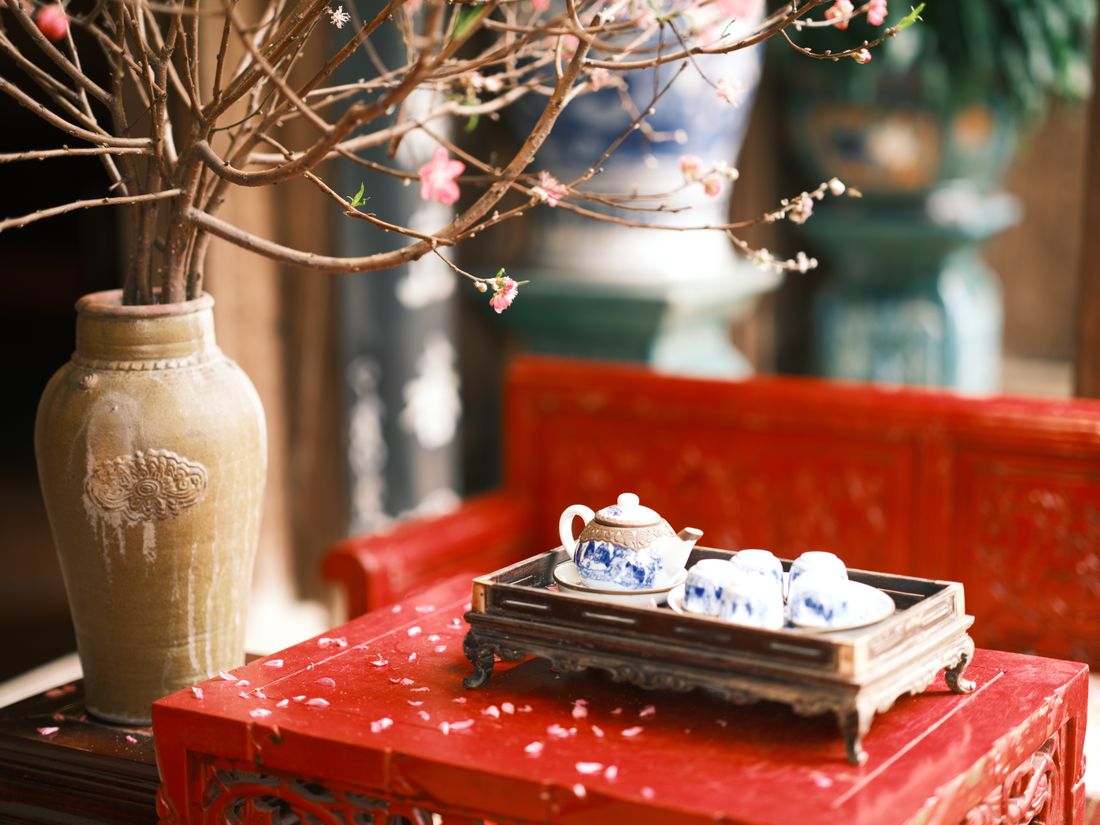
The mark on the base is the first thing everyone turns a vase over to read — and the last thing an experienced buyer trusts. Asian and tribal art is the one field where a confident inscription, a green stone and a dark patina are all easy to fake, and where the honest answer usually sits in the paste, the tool marks and sometimes the physics. Here is how we actually look at a piece in a Delray Beach home, so you know what stands behind an offer.
What we look for
- Chinese and Japanese porcelain and pottery
- Jade, coral, and hardstone carvings
- Bronzes, netsuke, and scroll paintings
- Ethnographic and tribal pieces
How we read Asian and tribal pieces — marks, jade, bronze and the fakes
A Chinese reign mark has a simple grammar. A six-character mark gives the dynasty (Da Ming, 1368–1644, or Da Qing, 1644–1911), the emperor’s reign name and a closing phrase meaning “made for.” A four-character mark drops the dynasty. It is usually written in regular script or in the angular seal script, and it sits centered on the base. Reading it takes a minute. Believing it is the mistake.
The nuance almost nobody explains: many marks are not dates. For centuries potters copied the marks of earlier emperors, often as a gesture of respect rather than to deceive. Collectors call these apocryphal marks. The Xuande (1426–1435) and Chenghua (1465–1487) marks are among the most copied of all; Ming marks turn up on Kangxi-period (1662–1722) blue-and-white; a Kangxi mark is commonly found on Guangxu-period (1875–1908) “revival” wares; and the Qianlong six-character seal mark is one of the most reproduced anywhere. Kovels makes the same practical point in its reader answers: fakes simply copy the original mark, so without real provenance a mark proves little. Dealers who know the field treat it as the last clue, not the first.
So we weigh the mark against everything it is supposed to agree with:
- Calligraphy and placement. An imperial-quality piece should carry a confident, well-formed mark. A clumsy one on a refined vase is a warning; a rougher mark on ordinary kiln ware is not.
- Paste, glaze and foot. The body, the way the glaze pools, the foot rim and the painting have to belong to the period the mark claims.
- Wear and drilling. A hole through the base is common: many marked vases were drilled and turned into lamps between the 1920s and 1960s. That cuts value but does not by itself make a piece wrong.
Jade. Jade is not one stone but two minerals, nephrite and jadeite, as Kovels notes. Most older Chinese carvings are nephrite; the two differ in density (roughly 2.9–3.0 for nephrite against about 3.3 for jadeite), so weight and a gemological test separate them where color cannot. The modern trap is treatment: so-called “B-jade” is jadeite bleached with acid and filled with polymer resin, and ordinary gem tests often miss it. A chalky blue glow under long-wave UV is a flag; infrared spectroscopy is the definitive check. Kovels also cautions that jade is still carved in the old styles, so new work passes easily for old.
Bronze and tribal work. On bronze we read the casting seams, the way the patina sits in recesses and grows through the surface rather than on top of it, and whether the weight and wall thickness make sense. On tribal and ethnographic pieces the key question is used or made for sale: ritual wear, handling polish and repairs made by the community are very different from the uniform, fresh-cut finish of work made for the tourist trade. None of these checks is decisive alone. Together they usually are.
The science most buyers (and most dealers) never mention
Museums and conservation labs do not settle these questions by eye. The same methods explain why we say “probably” so often, and why we know when a piece deserves a lab.
Thermoluminescence (TL) — the clock inside fired clay. Minerals in clay slowly trap electrons from natural radiation. Firing a pot above about 500°C empties those traps and resets the clock; from that day they refill. Heat the sample in a lab and it releases the stored energy as light, in proportion to the time since firing. Oxford’s luminescence group developed the method in the 1960s–70s, and it became a standard test for fired pottery, ceramics and even the clay cores left inside bronze casts. It exposed fakes in famous cases, including the “Hacilar” pottery from Turkey and supposedly Tang-dynasty and Hui Hsien-style ceramics from China. The catch: it needs a tiny sample, traditionally drilled from the object, and it works on fired clay only — not on jade, stone or bare metal. (Source: a review in Radiation Measurements, not arXiv; the electron-trapping principle also appears in an arXiv paper on glow curves.)
What arXiv now shows without touching the object. A January 2026 preprint put a Shang-dynasty bronze, the Fuhao piece from the 13th–11th century BCE, under pulsed thermal imaging. Without a scratch, the team located repair crevices, patches and filler in three dimensions and told restoration material apart from the original metal; the vessel turned out to be assembled from several fragments, with uneven corrosion and earlier conservation. For a buyer that matters: a bronze can be genuinely ancient and still heavily rebuilt, and the difference is large in value.
A second arXiv study, on a Sardinian bronze warrior, used neutron diffraction to read the alloy itself: a copper-tin bronze averaging about 7.5% tin with up to 2% lead, plus corrosion phases that signal what the metal is doing now. And Raman spectroscopy, argued in a paper by Philippe Colomban, identifies the body, glaze and nano-sized pigments of ancient ceramics and glass without damage, classing them by composition and firing temperature with portable instruments.
Lead-isotope analysis of ancient Chinese bronzes adds provenance: Shang metalwork contains unusually radiogenic lead pointing to several ore sources, though mixing and recycling blur the signal. We do not run a lab in your living room, and we say so. What this science gives us is discipline: when something is valuable enough, we recommend testing instead of guessing.
What actually drives the value
- Genuine period, not a famous mark. A plain, correct piece of the right age beats a lavish vase carrying a borrowed Qianlong mark. We price what the object is.
- Material and quality of carving or casting. Fine nephrite with good color and crisp carving, or a sharply cast bronze, outranks a large but soft piece.
- Condition and honesty of repair. Disclosed restoration is normal; hidden rebuilding, B-jade treatment or a drilled base moves the price.
- Provenance. Old collection labels, export papers, travel records and family history are worth real money in this field, because they are the one thing a forger cannot easily add.
- Legal status. Ivory, rhino horn and some feathers or shells carry federal and state rules, and dealing in them needs documentation. We tell you up front what can and cannot be bought.
If a piece is a charming decorative copy, you hear that plainly, and sometimes it is still worth something. If it might be important, we say that too, and we point you to the right specialist rather than offering a low number and hoping you do not check.
Not sure if your piece fits? Text a photo to (561) 465-3536 — we will tell you honestly and for free, with no obligation to sell.
Questions
Selling asian & tribal art in Delray Beach
Does a Chinese reign mark on the bottom mean my piece is that old?
Not by itself. For centuries potters copied earlier emperors’ marks, and the Xuande, Chenghua, Kangxi and Qianlong marks are among the most reproduced, often on pieces made in the late 1800s or 1900s. We judge the mark together with the paste, glaze, foot rim, painting and wear.
How can I tell if my jade is real?
Jade is nephrite or jadeite, and color alone will not tell you. Weight, a density test and magnification help, and treated “B-jade”, which is bleached and resin-filled, can fool standard tests. Send us clear photos first; for a high-value piece we recommend a gem laboratory report.
Will you come to my home in Delray Beach or Palm Beach County to look at Asian or tribal art?
Yes. We visit homes across Delray Beach and Palm Beach County, look at each piece in hand under good light, and give you an honest verdict on the spot. If we buy, we pay the same day. For a single item, a few photos of the front, the base and any marks are a good start.
Why does it matter that the buyer really knows this field?
Because it is full of convincing fakes, and every cost of a mistake lands on you. A buyer who cannot tell a period piece from a later copy will either overpay for a fake or, more often, offer a safe low number on something real. Someone who can read the base, the stone and the metal can pay fairly in both directions, and tell you when a piece needs a specialist.
Is scientific testing like thermoluminescence worth it for my piece?
Only for the right piece. TL can date fired clay such as terracotta and porcelain from a tiny drilled sample, but it does not work on jade or metal, and the sample, the lab fee and the small damage only make sense when the value is high. We will tell you honestly when a piece is worth testing and when it is not.